Home › Concrete Slab Installation
Leesburg Concrete Company pours level, durable concrete slab foundations for projects throughout Leesburg, VA. We install concrete slab bases for sheds, garages, patios, and additions, using proper compaction, reinforcement, and thickness for the load. Our team ensures accurate elevations, smooth finishes, and clean edges so your new concrete floor slab is ready for framing or use.
Leesburg Concrete Company provides professional concrete slab throughout Leesburg, VA, Virginia and the surrounding area. Our licensed, insured crew delivers safe, clean, on-time work with a free estimate before anything begins. Call (571) 601-2614 or request your free quote.
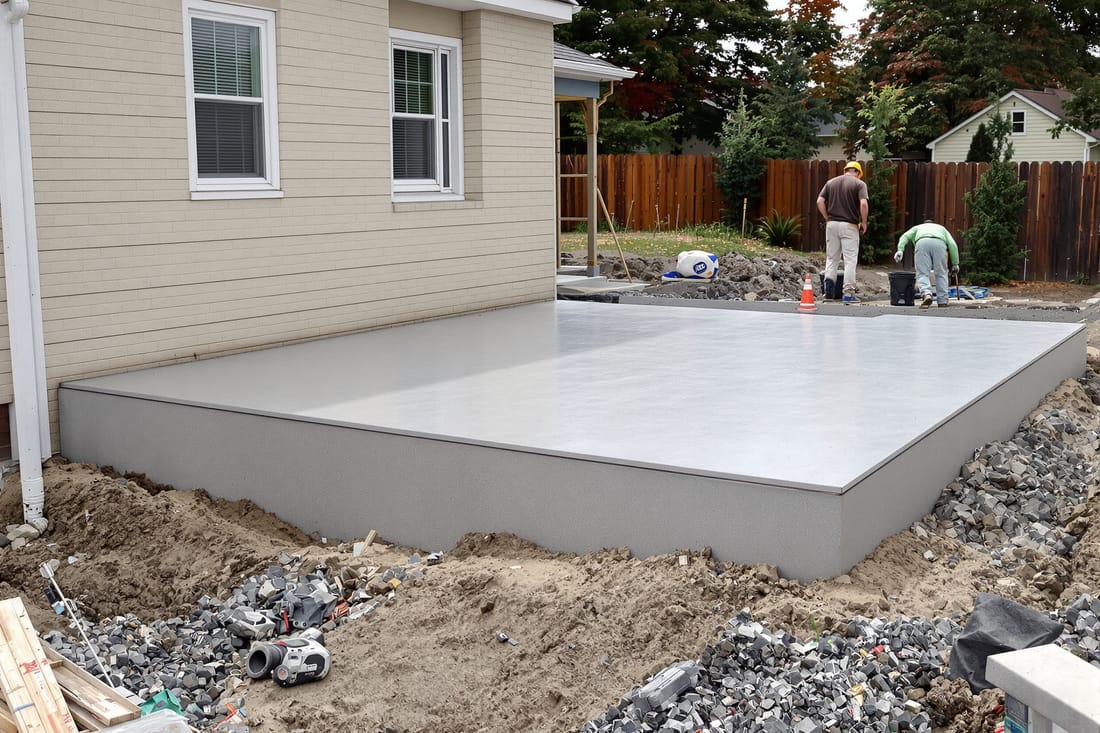
Concrete slab installation in Leesburg that holds up to real use
Concrete slabs look simple from the surface, but how they are built underneath is what decides if they last 3 years or 30. Leesburg Concrete Company focuses on the parts homeowners and builders in Leesburg, VA rarely see, like soil prep, drainage, and reinforcement. That is where most slab problems start.
In Loudoun County we deal with clay-heavy soils, freeze-thaw cycles, and occasional heavy rain that can wash out poorly compacted base. A slab that might work fine in a dry, sandy area will crack or settle here if the base and reinforcement are not designed for our conditions. When we put together a concrete slab project, we look at what will be sitting on it, how water moves across your yard, and where frost lines hit in Leesburg so the slab stays stable.
Whether you need a patio slab, shed or barn foundation, garage floor, hot tub pad, or a slab for an addition, the same principle applies: control the ground and the water first, then pour the concrete. Leesburg Concrete Company uses mix designs and reinforcement layouts that match the job, rather than a one-size-fits-all approach that often shows its weaknesses within a few winters.
How we build a concrete slab step by step
Every concrete slab installation we do in Leesburg follows a clear process so there are no shortcuts that come back to haunt you.
1. Site visit and layout. We start by walking the site with you, checking grades, access for trucks, overhead wires, and nearby structures or septic components. We mark the slab outline, discuss final height relative to doors or existing patios, and plan where water will drain.
2. Excavation and subgrade prep. We strip sod and organic material, then excavate to the depth needed for the stone base and slab thickness. In much of Leesburg the native soil is clay, so we proof-roll the area and remove any soft pockets instead of burying them. A plate compactor or roller is used to densify the subgrade, which helps prevent future settling.
3. Stone base and compaction. We typically install 4 to 8 inches of compacted crushed stone (such as 21A or similar aggregate) depending on the load the slab will carry. For garages, driveways, and hot tub pads we stay on the thicker side. The stone is spread in lifts and compacted thoroughly to reduce air pockets that can cause slab movement in freeze-thaw conditions.
4. Forms, reinforcement, and vapor barrier. Treated lumber or metal forms are set to finished height and checked with a laser for slope and level. For most slabs we use welded wire mesh or rebar on chairs so it sits in the middle of the slab, not at the bottom where it does little good. For interior slabs or spaces that will receive flooring, we add a vapor barrier to reduce moisture coming up through the concrete, which matters in humid Leesburg summers.
5. Mix selection and placement. Leesburg Concrete Company orders concrete mixes based on the job needs, typically 3,500 to 4,000 psi for residential work, with air entrainment for exterior slabs that face winter de-icing salts and freeze-thaw cycles. We manage truck timing so the concrete is placed and finished within proper working time. The concrete is poured, spread with rakes, struck off with a straight edge, and bull floated to bring up paste and level the surface.
6. Control joints and finishing. Joints are cut or tooled in the slab at planned intervals to direct shrinkage cracks. For patios and work areas we often use a broom finish for slip resistance, while interior spaces or garage floors may get a steel trowel finish if appropriate. Around doors or equipment pads we spend extra time on smooth transitions so you are not fighting trip edges or water pooling.
7. Curing and protection. Proper curing is what gives the slab long-term strength. We typically apply a curing compound or cover the slab, and we will give you clear guidance on when you can walk on it, set light items, or drive vehicles on it. Most light foot traffic is fine after 24 to 48 hours, but we recommend waiting at least a week for vehicles and longer for heavy loads so the concrete can gain strength.
Design choices that affect how your slab performs and looks
Concrete slab installation is not just thickness and strength. A few choices made before the pour will decide how well the slab fits your use and how much upkeep it needs.
Thickness and reinforcement: For basic patios and walkways, 4 inches of concrete is standard. For garage floors, RV pads, and heavy workshop slabs, 5 to 6 inches and more frequent rebar reinforcement is often worth the added cost. Leesburg Concrete Company will talk through what will sit on the slab and whether vehicles, equipment, or future walls are planned before setting the design.
Drainage and slope: In our local climate, melt and rainwater must have a clear path away from the house. Exterior slabs are usually sloped about 1/8 to 1/4 inch per foot away from structures so water does not run toward foundations or door thresholds. For interior slabs or enclosed spaces we discuss floor drains, where allowed by code, and how to keep water from neighboring grades from getting under the structure.
Surface options: Most customers choose a standard broom finish because it is durable and easy to maintain, especially with occasional snow and ice. For outdoor living areas, we can add color, saw-cut patterns, or a light texture that blends with pavers or existing hardscape. In workshops or basements, a harder troweled finish might be chosen if you plan on using epoxy coatings or roll-out mats.
Crack control strategy: All concrete will crack, but smart planning keeps cracks narrow and where they do not bother you. We design a joint layout that accounts for slab size, shape, and openings such as columns, stair pads, or posts. Around Leesburg, temperature swings between winter and summer are enough to move large slabs significantly, so joint placement is not something we leave to guessing on pour day.
Edges and transitions: The edge of a slab is where chipping usually starts. We often tool and round the edges, or add thickened edges for slabs that will see equipment rollers or trailer jacks. At garage doors or doorways to the house, we coordinate height so thresholds seal correctly and you do not end up with a bump that makes snow shoveling or sweeping harder than it needs to be.
What affects cost and timing for concrete slabs in Leesburg
Two jobs that look similar on paper can be very different in cost once we see the site. Leesburg Concrete Company gives straightforward pricing that reflects what it will actually take to build a slab that holds up under local conditions.
Site access: Tight backyards in older Leesburg neighborhoods or lots with limited truck access can require smaller loads or pumping, which affects price. If we need to haul material in and out by machine or wheelbarrow instead of direct truck access, labor time increases.
Soil and base conditions: If we find soft spots, buried debris, or old fill that was never compacted, we may need to remove and replace it with compacted stone. This is an area where cutting corners today leads to settlement and broken slabs later. We will walk you through options if we find issues when we dig.
Slab size, thickness, and reinforcement: Concrete volume is a direct cost driver, but so is the type and amount of steel. A small patio slab with wire mesh will cost less per square foot than a thickened-edge, rebar-reinforced garage slab designed for trucks. We also consider whether thickened areas are needed under load-bearing walls or columns.
Weather and season: In Leesburg, late fall, winter, and early spring pours can require cold weather measures like insulated blankets or special accelerators, which add to cost. Summer heat can call for earlier start times, extra finishing crew, or set-retarding admixtures so the concrete does not cure too fast. When we schedule your project, we factor in the time of year and forecast so there is adequate curing time without rushing.
Permits and inspections: Some slabs are considered structural or part of an addition and may need permits and county inspections. Others, like small patios or shed pads, may not. We can help you understand where your project falls and coordinate with your builder or the county if needed so you are not surprised mid-project.
Common problems we prevent and what to ask before you hire
Most slab failures in Leesburg could have been prevented at install. When Leesburg Concrete Company meets a customer about a new slab, we also look for early warning signs on nearby concrete so we can avoid the same outcome.
Freeze-thaw damage and spalling: In our area, de-icing salts and repeated freezing can cause the top layer of concrete to flake off if the mix or finishing was wrong. We use air-entrained mixes for exterior slabs and avoid finishing practices that trap too much water at the surface. We also recommend when and how to seal the slab if you plan to use de-icing products.
Random cracking and settlement: Long, wandering cracks or sections that have sunk usually point to poor subgrade, missing joints, or thin sections. Our approach with compacted stone base, planned joint layout, and consistent thickness greatly reduces these risks. We will show you on the layout where joints will go so you are not surprised later.
Water against the foundation: A slab poured level or back-pitched to the house can push water toward your basement wall. We watch elevations closely and often adjust grades or recommend small retaining changes so water flows away from your structure. This is especially important for patios that sit outside basement walkouts or on sloped yards around Leesburg.
Before you hire any concrete contractor, ask how they prepare the base, what mix they will use, how they handle expansion and control joints, and what their plan is for curing. Ask to see a joint layout, not just hear that they will “cut them later.” A reputable company should be able to describe their process in detail without relying on vague promises.
If you are planning a concrete slab in Leesburg, VA, start the conversation with your intended use, expected loads, and timing. Leesburg Concrete Company will respond with a clear plan that covers subgrade prep, reinforcement, mix design, finish, and curing, so you know exactly what you are getting and why it will last in our climate.